Uncategorised

El Instituto Nacional de Colonización fue creado en 1939 buscando una reforma económica y social de la tierra. Buscaba fijar poblaciones en el entorno rural favoreciendo los regadíos y la concentración de tierras.
Este álbum, compuesto por 29 fotografías, obra del fotógrafo valenciano Francisco Pérez Aparisi, recoge la actividad de esta institución en la provincia de Castellón.
El álbum esta editado con motivo de los 25 años de la actividad del instituto (luego está datado en 1964) y todas y cada una de las fotos están parcialmente pegadas sobre cartulina blanda con la identificación del lugar fotografiado y el sello del fotógrafo al dorso.
Curiosamente el álbum ha sido adquirido en subasta por un precio simbólico.
Estas fotos complementan, en el tiempo, la sección de las fotos de turismo (Dirección General de Turismo) que se encuentran en esta misma Web.
El Instituto Nacional de Colonización (INC) se crea el 18 de octubre de 1939 como instrumento de la nueva política agraria franquista, dependiente del Ministerio de Agricultura. La estrategia política del Nuevo Estado sustituye la redistribución de la tierra (objetivo de la Segunda República) por una política de colonización basada en la transformación del medio rural (introducción del regadío y aumento de la productividad) que permitiera asentar en pueblos de colonización un campesinado autosuficiente .
- Pueblos de la colonización durante el franquismo. Junta de Andalucía.La arquietectura en la modernización del desarrollo rural.
- Cuando las palabras ocultan la arquitectura. Rafael Zarza. ( estudio sobre las fotos de Kindel de los pueblos de colonización especialmente su relación con Fernández del Amo)
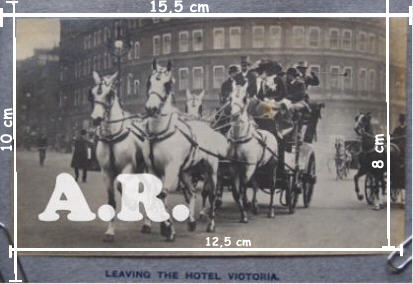
Gelatin Silver
Photo: 8 cm x 12,5 cm
Page: 10 cm x 15,5 cm
FORMAT OF THE BOOK
- Personal card of Alfred G. Vanderbilt
- Portrait of Alfred G. Vanderbilt
- 18 images of the trip
- Red suede cover
- Each photo is in a cardboard
CONDITION
The photos, and specially the cover of the album, are in perfect conditions.
In this album we don't have the name or signature of the photographer.
However, due to the quality of the photos, as well as due to Alfred G. Vanderbilt's wealth, the photographer was probably a famous one on those days with a study in London or Brighton.
This gelatin silver photos show in a short and clear way the trip between both cities moving us to vintage, romantic and beautiful times.
Here you can see the 19 vintage pictures of Alfred G. Vanderbilt's London-Brighton journey on the coach called Venture
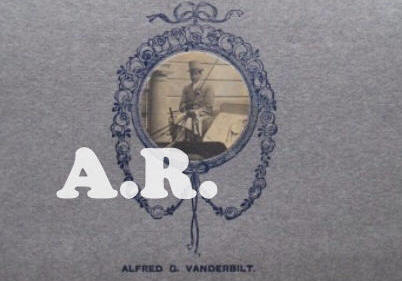 |
Alfred G. Vanderbilt |
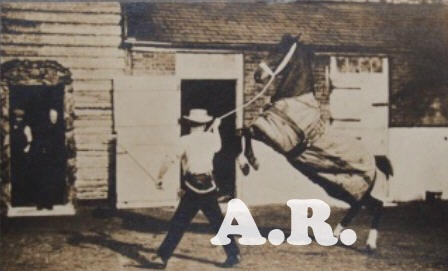 |
A bit green |
 |
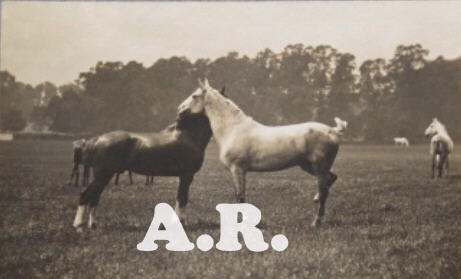
First impressions of England |
 |
On the way to the farm |
 |
At the farm |
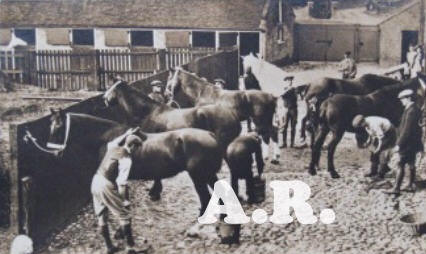 |
Their morning dressing |
 |
In single harness |
 |
Leaving the Hotel Victoria |
 |
The first change |
 |
Approaching Kingston |
 |
Epson market place |
 |
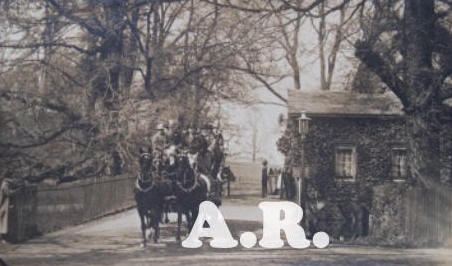
Crossing Ashtead Common |
 |
Leaving Norbury park |
 |
Burford Bridge hotel |
 |
Through Holmwood |
 |
Warnham cross roads |
 |
The change at Pyecombe |
 |
Sussex downs |
 |
Arrival at Brighton |
THE RACE: LONDON-BRIGHTON
The city of Brighton is one of the favourite cities to spend the summer or the weekend for the people of London because of its beaches. It was appreciated by the British Crown and the royalty.
Nowadays is less than an hour away from London.
Coaches were the main vehicle used to go from London to Brighton in the XIX. The road was being improved throughout the century and establishing several hotel or small houses where to rest the horses and people.
From 1907 and for six weeks in the summer, the Venture makes a successful trip as we can read in this 1913 news in the New York Time
http://query.nytimes.com/mem/archive-free/pdf?res=9B03E6DA153FE633A25750C1A9619C946296D6CF
“Alfred G. Vanderbilt’s London Brighton coaching season, which closed this week, has attracted a greater number of passengers than in any previous year. Mr. Vanderbilt has left London and is sailing for America on La France.”
Links: