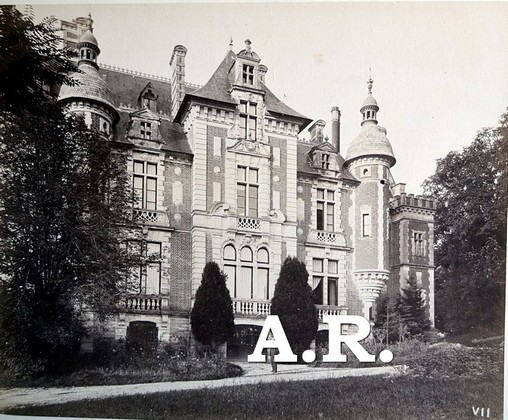
From La Bibliothèque nationale de France (BnF) I got the following confirmation on Lampué live and work:
- Jean Pierre Philippe Lampué was born in Montréjeau in 1836. Died in Paris in 1924.
- He studied at the Seminary of Polignan and in the School of Beautiful Arts in Toulouse. He could have travelled to Spain in 1864.
- In 1865 he stablished in Paris, rue Saint Jacques 237.
- Lampué become official photographer of the École of Beaux Arts of Paris.
- In 1888 he became councillor of the 5th District of Paris.
- In 1890 he became radical socialist and gets elected as municipal councillor of Paris for the Val de Grace neighbourhood. In the council he belonged to the comission of "teaching and beautiful arts".
- In 1892 he became part of the Honour Comitee for the First International Exposition of Photography and Industry as councillor of Paris.
- Lampué was re-elected as councillor in 1893 and 1896 but lost in 1900 elections.
- He was member of the French society of Photography from 1873 to 1885.
- He was member of the Chamber of Labour Union of Photography.
- Lampué participated in expositions by the French Society of Photography in 1876 and 1882.
- He had his own photographic studio in rue Saint Jacques 237, in Paris until 1879. It was called "French-Spanish photography".
- This studio was later moved to the Boulevard Port Royal 72 in Paris.
- He finishes his photographic activities in 1890.
In the George Eastman House database, we can find the following information:
- Name: Jean Pierre Philippe Lampué
- Active in France c.1870
- Member of the French Society of Photography
- Museums with artwork of Lampué
- J. Paul Getty Museum
- Rikjsmuseum Ámsterdam
- Snite Museum of Art
- Expositions
- Onzienme Exposition de la Société Nacional de Photographie en 1876. Palais de la Industrie
- Exposition Universelle 1878
Lampué became famous also because he faced the impresionist, publicy, on the press:
'Quand un tableau vous semble mauvais,' he declared, 'Vous avez un incontestable droit: celui de ne pas le regarder et d'aller en voir d'autres. Mais on n'appelle pas les gendarmes.'
Excellent answer, by the way.
Apart from this information, I have found:
- He also has pictures in the Museé D'Orsay (see link, and look for Lampué) and at Museé de Chantilly.
- Expositions in 1889 in the National Library of France: "La Maxiphotographie au XIXe. Siècle."
- Lampué and his son received the silver medal at the International Exposition in 1889.
- Lampué is an heliographic editor. The national archives of France received in 1879, 21 heliographic planches of the most important monuments in Paris (for more information about heliography see this link).
- You can find several of his pictures at the Culture France web: http://www.culture.fr/content/search?SearchText=lampue&SubTreeArray=1&SearchButton=Search
-
Jean-Pierre Lampué (1836 – 1924)Président du Conseil Général de la Seine en 1904 et 1905Vice-président du Conseil municipal de ParisRapporteur général du budget du département de la SeineDessinateur et photographe d’art spécialisé dans la photographie d’architecture
-
Cat'zArts: Beaux-arts de Paris, l'école nationale supérieure Photographies de Lampúe
.............Cat’zArts, qui tire son nom du bal des Quat’z-arts organisé par les élèves des quatre sections de l’Ecole, est un catalogue informatique qui présente les œuvres des collections de l’Ecole nationale supérieure des beaux-arts. Ces collections, héritées des Académies royales, augmentées par de prestigieuses donations et par les travaux scolaires jusqu’en 1968, sont extrêmement variées et comportent aussi bien peintures, sculptures, objets d’art, dessins de maîtres et d’architecture, que photographies, estampes ou Livres et manuscrits. Sur un total de plus de 450 000 œuvres, près de 80 000 figurent déjà dans la base................ -
Photographies de Lampúe. Sturgis collection
..........American architect Russell Sturgis (1836 –1909) was a leading figure in the development of architectural criticism at the turn of the 20th-century. During his formative years in New York, Sturgis gained an appreciation for architectural history and modern design. An advocate of the American Pre-Raphaelites, Sturgis sought much inspiration in the written works of English architect and critic John Ruskin. Upon his return to New York after extensive travel abroad, Sturgis opened his own architectural practice in 1863. In addition to his success as an architect, Sturgis authored countless articles and books on various architectural subjects.
After 1858, Sturgis earnestly began to collect choice photographs and drawings of various architectural gems. Sturgis' collection of photographs is particularly rich in both its collective thoroughness and diversity of images represented................. - He is in the list of Les Architectes eleves de l'école des beaux art
-
BNF DATA
- Jean Pierre Philippe Lampué (1836-1924) - Toutes ses œuvres
-
Portes monumentales et portes cochères de Paris1884
École des beaux-arts de Paris. Programmes des concours d'architecture pour le grand prix de Rome, photographiés et publiés par Pre Lampué,...1881
Notice biographique sur Pierre-Philibert Pompée, instituteur, premier directeur de l'école municipale Turgot, fondateur de l'école professionnelle d'Ivry"1875Léon ChateauJean Pierre Philippe Lampué (1836-1924) comme Photographe
[Recueil. Photographies positives et impressions photomécaniques. Oeuvre de Lampué]187.
"[Recueil. Oeuvre de Lampue]"Jean Pierre Philippe Lampué (1836-1924) comme Illustrate
-
Other artwork from Lampué:
- "Architecture Antique. Restauration des Monuments Anciens. Dessins originaux des Architectes Pensionnaires de l'Academie de France a Rome". Photographies de Lampué. 3e Volume. Armand Guérinet, editor
- Several cartes de visite.
Lampué worked as a photographer at L'École National Supérieure des Beaux-arts. At its digital Library we can do a search for "Lampué". There we would find several documents by Lampué, but none of them are from this album.
Cat’zArts, qui tire son nom du bal des Quat’z-arts organisé par les élèves des quatre sections de l’Ecole, est un catalogue informatique qui présente les œuvres des collections de l’Ecole nationale supérieure des beaux-arts. Ces collections, héritées des Académies royales, augmentées par de prestigieuses donations et par les travaux scolaires jusqu’en 1968, sont extrêmement variées et comportent aussi bien peintures, sculptures, objets d’art, dessins de maîtres et d’architecture, que photographies, estampes ou Livres et manuscrits. Sur un total de plus de 450 000 œuvres, près de 80 000 figurent déjà dans la base.